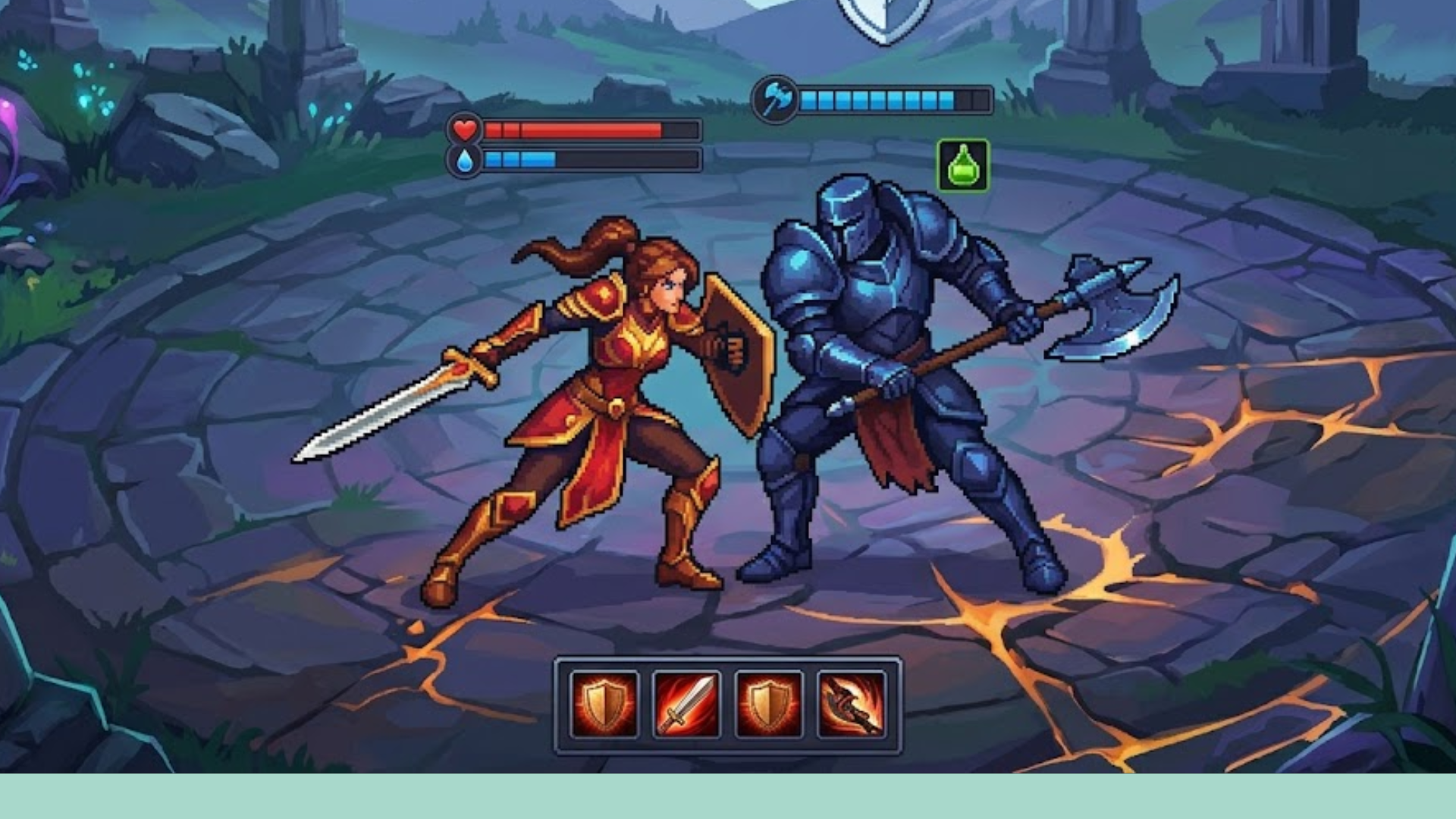
Present in most game genres, combat mechanics have become a key element supporting the experience, sometimes even becoming the core of the game itself.
Looking at the definition of combat, we indirectly find the genres that have made it a central axis of their gameplay.
Combat:
A confrontation, limited in space and time, between opposing ground, air, or naval formations -> Strategy games, Tactical RPG
The act of fighting against opposing forces -> Action-RPG, FPS, Beat'em all, Turn-based RPG
A contest in which two opponents face off in sporting games under certain rules to win a title or trophy -> Fighting game
What every combat system shares
Every combat system has adopted a common classification of combat actions. These broad families break down as follows:
- Basic offensive actions: light attack, heavy attack, charged attack, attack while moving, aerial attack, backstab
- Defensive actions: blocking (active/passive), parry (precise timing), dodge/roll, defensive dash, invincibility (i-frames), cover/taking shelter
- Repositioning actions in combat: retreat, sidestep, cancel, offensive dash, jump in combat
- Special skills and abilities: special moves (directional input, SF2), magic/active abilities (spell, skill), ultra/super (gauge), cooldown-based skills (action RPG), burst/limit break
- Combat resource management: stamina, focus/posture points (Sekiro), mana/MP, ammunition, skill charges
- Situational actions: finisher/execution, grab/grapple, counter-attack (parry reward), area attack, targeted attack (multiple enemies)
- Turn-based specific: passing your turn, defending (damage reduction), healing, repositioning on the grid, using an item
Genre specifics
While the fundamental building blocks are shared, what sets genres apart is how they prioritize them. Each genre makes choices: it puts certain types of actions at the center while pushing others into the background or removing them entirely.
Fighting games — Street Fighter II, Tekken
In a fighting game, combat is the game. There's no exploration, no narrative progression between exchanges. Two characters face off in an arena. Simple, effective.
What defines the genre is the density of decisions each player has to make within a very short window of time. Every action has a duration measurable in frames: an attack that starts up in 5 frames beats a defense that activates in 8. Frame data, even when a player never consciously consults it, structures every exchange. It determines whether a punish is possible, whether a combo connects, whether a move is "safe" or not.
More simply, fighting games rely on a rock-paper-scissors logic: attacks beat grabs, which beat blocking.
Space is a resource in its own right. The corner, that part of the arena where an opponent is pinned against the wall, is a position of dominance: escape options shrink, and mix-ups become more effective.
Street Fighter II laid the foundations of the genre in 1991 by making controls reliable for the first time. Before it, special inputs were too imprecise to be used consistently. With it, a forward quarter-circle motion followed by a punch produced a Hadoken every time.
The fighting game is the genre where defensive actions are the most visible and the most valued. Blocking, parrying at the right moment, punishing mistakes: victory comes as much from what you don't do as from what you do.
FPS — Doom, Halo, Counter-Strike
In an FPS, the player's body is replaced by a first-person view: you see your hands, sometimes your weapon, and that's it. Yet positioning in space remains central: whoever controls the angles controls the fight.
The genre's signature mechanic is weapon management. Each weapon has an optimal range, a reload time, a recoil pattern.
Knowing which weapon to pull out in which situation is a key decision, often made in a split second.
Doom Eternal turned this into an almost rhythmic system: the shotgun for close range, the plasma rifle against shields, the chainsaw to recover ammo. The player juggles weapons as a resource-management tool, not just as an offensive choice.
Dodging in an FPS rarely relies on a dedicated mechanic. It happens through movement: backing away, taking cover behind an angle, stepping out of the line of fire. In Counter-Strike, running makes noise and worsens accuracy. Sprinting toward a point versus walking quietly to preserve an acoustic advantage is a combat decision, even if no shot is fired.
Readability is especially critical here. In a close-range exchange, everything happens within a few dozen milliseconds. Hitboxes, impact feedback (the red flash on screen, the sound of a landed hit), and the clarity of enemy animations are survival tools as much as polish details.
Beat’em all & Hack & Slash — God of War, Devil May Cry, Diablo
Beat'em alls and hack & slash games share one thing in common: the player is almost always outnumbered by enemies. Combat isn't fought against a single opponent in a duel, but against a group.
The core mechanic shifts from reading a single opponent to managing a crowd. Who to hit first, how to avoid being surrounded, how to use space to avoid getting sandwiched.
In God of War (2018), the Leviathan axe serves as both a close-combat tool and a recallable projectile: the ability to engage multiple enemies at different ranges allows for varied approaches.
Devil May Cry pushes this logic toward something more "expressive." The game continuously evaluates the quality of combat through a style gauge. Chaining varied actions without repetition raises the score. Taking hits lowers it. The goal isn't just to win, but to do it with style.
Diablo's Like (Diablo & Path of Exile 2, whose open beta v0.5 open beta arrives on 05/29/2026...) emphasize two fundamental aspects of combat mechanics: snappy movement (whether natural or skill-based) and combining skills to deal maximum damage.
Action-RPG — Dark Souls, Elden Ring, The Witcher 3
The action-RPG is the genre where defensive actions are the most costly to mess up: the mechanics are explicitly designed to carry consequences.
Dans les Souls like (Dark Souls and Elden Ring for example), stamina is the central resource. Every roll, heavy attack, or shield raise consumes it. The bar drains fast and regenerates slowly, punishing players who attack without keeping track of what they have left. The stamina gauge isn't a minor system detail: it's one of combat's central metrics, forcing the player to think between hits rather than mash buttons.
Parrying, in these games, is a form of reward for the most attentive players: requiring precise timing on an enemy's attack animation, a successful parry opens a critical counter-attack window. If you read your opponent perfectly, you deserve something in return.
The Witcher 3 operates differently; dodging and rolling are more forgiving, and magical resources (the Signs) add a layer of situational control. Combat here is less punishing in its timing demands and more strategic in its choice of tools. Yrden to slow enemies down, Igni to burn them, Aard to knock them off balance: each enemy situation has an optimal answer to find.
Turn-based RPG — Baldur’s Gate 3, Dofus
Turn-based combat removes real-time pressure. There's no input to execute in a split second, no timing to respect. Instead, there's a wider space for thinking.
In Dofus, each character has Action Points and Movement Points per turn. Moving consumes MP, using a skill consumes AP. The total is fixed and tight, and every turn starts with the same question: what can I do, and in what order? Combat here is a constrained optimization problem, renewed each turn.
Baldur’s Gate 3 enriches this principle with verticality and environmental interactions. Pushing an enemy off a ledge, igniting a pool of oil, using a fog spell to cover a retreat: the possibilities are numerous and create solutions the game never explicitly planned for. Winning a tough fight through an unexpected combination is one of the game's most satisfying moments.
Turn-based is also the only genre where passing your turn is a valid tactical decision. Defending to reduce incoming damage, waiting for an ally to act first, repositioning without attacking: inaction is (paradoxically) an action in its own right.
Leave a Reply