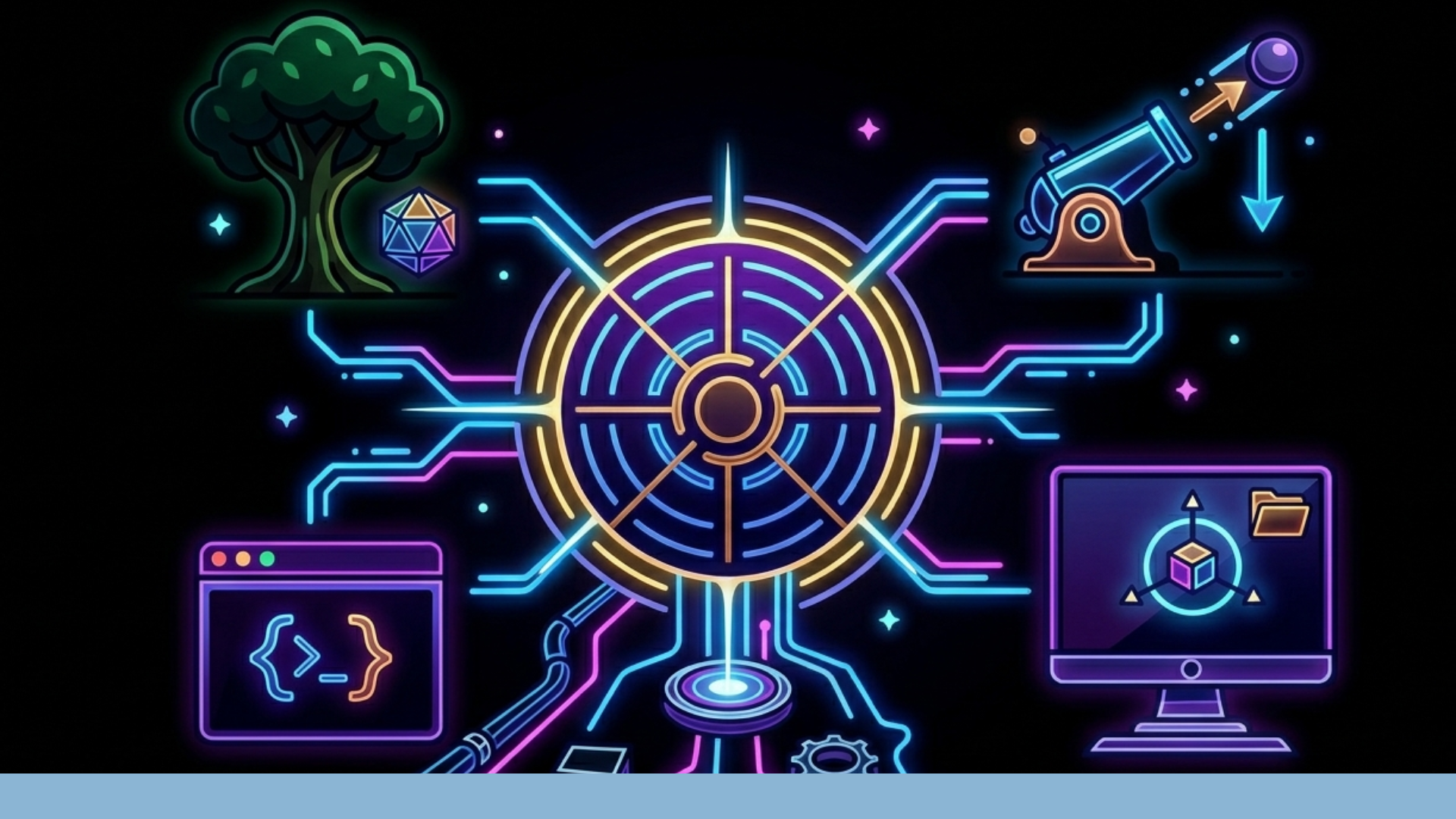
When we talk about video games, we talk about gameplay, story, artistic direction. Rarely about the technical layer that makes all of it possible. Yet the game engine is where everything begins: before the first pixel is displayed, before the first line of dialogue is recorded, there's a tool deciding what the game can do, how it does it, and at what cost. As a newcomer trying to understand how games are built, I quickly realised that skipping over the subject of engines meant missing an entire piece of the industry's logic.
A brief history: from craft to infrastructure
In the 70s and early 80s, every game is a total handmade construction. Developers write everything from scratch: keyboard input handling, screen display, collision detection, sound. Almost nothing is reusable from one project to the next. It's a world where the programmer is engineer, architect, and labourer all at once.
The turning point comes in 1993 with Doom, developed by id Software. John Carmack designs a rendering engine modular enough to be separated from the game's content itself. A seemingly simple idea, but one that changes everything: the engine on one side, the levels, enemies, and textures on the other. This separation allows id Software to license its technology to other studios, opening the door to an entirely new business model.
The 2000s accelerate democratisation. Unity launches in 2005, Unreal Engine gradually opens its source code, and for the first time, a solo developer or small team can access professional-grade tools without building their technical infrastructure from the ground up. The era of the engine as a common good has begun.
How it actually works
A game engine is a software toolkit that groups together everything a developer needs to create an interactive experience. At its core sits a rendering engine, communicating with the graphics card to display images on screen. Around it orbit a physics engine to handle collisions and object interactions, an audio system, animation tools, a scene manager, and often a visual editor so designers can work without touching code directly.
What distinguishes a modern engine from a simple library kit is the integration of all these systems into a coherent environment. A level designer can place objects, define their behaviour, test in real time. A programmer can write game logic without rebuilding the rendering engine with each update. This division of labour isn't incidental: it shapes team sizes, development timelines, and ultimately, what a studio can afford to create.
Why it's indispensable
Building a game without an existing engine is possible. It's just extraordinarily costly in time and resources. Every feature has to be invented, tested, maintained. The slightest OS or target platform update can break everything.
The engine solves two fundamental problems. First, portability: a game developed on a well-designed engine can be exported to PC, consoles, and mobile with reasonable effort, where a custom solution would require major rebuilds for each platform. Second, team specialisation: when the engine handles low-level technical complexity, game designers, artists, and level designers can focus on what gives the game its value. That's why large productions today employ far more artists than programmers.
The three essentials
Unreal Engine

Unreal Engine is Epic Games' engine, born in 1998 with the game of the same name. It has established itself as the AAA reference thanks to its graphical power, advanced visual tools, and capacity to handle large-scale open worlds. Unreal Engine 5, released in 2022, integrates technologies like Nanite for geometric management and Lumen for real-time global illumination, enabling levels of detail previously reserved for cinema. Fortnite, developed by Epic Games themselves, runs on Unreal Engine 5 and literally serves as a testing ground for new versions of the engine.
Unity

Unity built its dominant position from a different angle: accessibility. Launched in 2005, it democratises game development by offering a complete environment, simplified multiplatform deployment, and an Asset Store allowing ready-made components to be purchased. It's the engine of choice for the mobile industry and independent development. Blizzard's Hearthstone , the collectible card game that redefined its genre, was developed entirely in Unity, demonstrating that the engine can produce AAA-quality experiences well beyond the indie market.
Godot

Godot occupies a unique space: it's an open-source engine, free and open, maintained by a community of contributors. Its permissive licence makes it a credible alternative for studios looking to avoid dependency on a third-party publisher. Its popularity has surged in recent years, particularly among independent developers. Rift Riff, a critically acclaimed strategy tower defense with 96% positive reviews on Steam, is developed in Godot and even appears in the engine's official release notes as an example of its capabilities.
Niche engines
Beyond the dominant trio, a range of tools serve more specific uses, yet have left a lasting mark.
GameMaker is one of the oldest creation environments accessible to non-programmers. Its longevity has made it the birthplace of several indie classics, including Toby Fox's Undertale , an RPG with an evasion-based combat system that defined an entire generation of players.
RPG Maker targets an even narrower niche: Japanese-style role-playing games. Its extreme accessibility has allowed creators without technical training to produce works like Freebird Games' To the Moon , a moving story about memory and regret that proves a limited tool can serve a strong artistic vision.
Other solutions like GDevelop, entirely code-free, or Ren'Py for visual novels, round out an ecosystem covering a very broad range of creative needs.
In-house engines
Some studios never wanted to depend on a third-party tool. Developing your own engine is a massive investment, but it's also a form of technological sovereignty: total control over performance, perfect optimisation for a specific genre or world type, no licensing constraints.
id Tech, id Software's original engine, is the one that laid the foundations for the entire industry. Doom Eternal runs on id Tech 7, a direct evolution of the technology born in 1993.Bethesda's
Creation Engine , distant heir to the Morrowindengine, powers The Elder Scrolls V: Skyrim and generations of open worlds with deeply simulated systems. EA/DICE's
Frostbite , initially developed for Battlefield, handles real-time environmental destruction with remarkable precision, as Battlefield 1 et ses tranchées qui s’effondrent sous les obus.
Finally REDengine powered Cyberpunk 2077 with levels of visual and narrative ambition that pushed the engine to its absolute limits.
When the in-house engine becomes a burden
But technological independence has a price. Maintaining an in-house engine requires a permanent dedicated team, constant technological monitoring, and the capacity to absorb costs that commercial engines spread across thousands of studios. When a project's ambitions exceed what the internal technology can handle, the calculation changes.
CD Projekt Red experienced this firsthand. After Cyberpunk 2077, the studio announced it was dropping REDengine in favour of Unreal Engine 5 for its upcoming projects, including The Witcher IV. The reasoning is pragmatic: let Epic Games handle the low-level problems, like open-world streaming or crowd rendering, and concentrate internal resources on what gives CDPR its value, namely writing, direction, and quest design. It's a lucid admission that the in-house engine, symbol of total mastery, can also become an obstacle to scale.
This shift isn't isolated. More and more studios that maintained their own technology are migrating to Unreal Engine 5, drawn by its advances and the shared R&D costs it represents. The reference commercial engine has become powerful enough that the gap with bespoke solutions no longer always justifies the investment.
Conclusion
Choosing a game engine is not a trivial technical decision. It's a bet on a development philosophy, a vision of the relationship between tool and creation. Opting for Unity means choosing portability and accessibility. Unreal means aiming for power and visual ambition. Godot means asserting independence and freedom. Building your own engine means claiming total sovereignty, at the cost of colossal effort.
For someone learning game design, understanding engines means understanding the constraints within which teams work. Not to know how to code, but to grasp why certain things are difficult, why certain studios take technological risks, and how the tool shapes, sometimes as much as talent does, what the game becomes.
Leave a Reply