Le Gladiatrool est un mode de jeu relativement nouveau sur Dofus RetroThe Gladiatrool is a relatively new game mode in Dofus Retro, distinct from the game's usual activities (farming, dungeons, crafting, and so on).
The premise is straightforward: choose a class (specially modified for this mode) and clear 9 rooms before facing a final boss in the 10th. Each room ramps up in difficulty, while your character's base power grows alongside it, boosted further by bonuses purchased with tokens earned through combat.
A Gladiatrool session unfolds as follows:
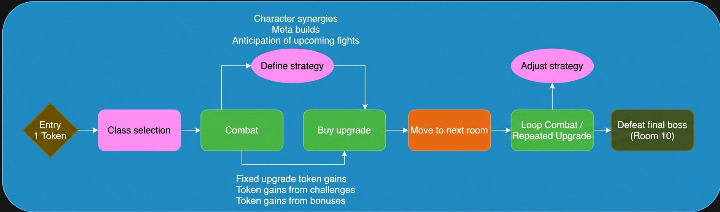
The Gladiatrool's gameplay loops
The micro-loop: immediate action
Three categories coexist within the micro-loop.
Combat actions come first: attacking, repositioning, casting spells. This is the tactical core of the Gladiatrool, identical to standard Dofus Retro, but concentrated around a reduced spell kit. No build to optimise beforehand, no gear to manage: just level 6 spells and a shared stat baseline. It forces a different way of reading combat. You think less about what you have, and more about what you do.
Upgrade actions come next: choosing a bonus between rooms, buying a potion. This moment lasts only a few seconds, but it carries the full decisional weight of the mode. Do you strengthen a dominant spell or patch a weakness? Do you play to survive the next room or hold out until the boss? It's a micro-decision with macro consequences. And it's often where a run turns.
Finally, out-of-combat movement: navigating between rooms, staying grouped with your partner. This is the most discreet dimension, but it reveals an interesting design constraint. Rooms are assigned randomly at the end of each fight. If both players don't stay together, they end up separated in different rooms. No unnecessary complexity: it's a way of making coordination visible and concrete.
The session loops: the run's rhythm
Two loops chain together at this level: combat and upgrading. Together, they produce something precise, a progressive and readable power escalation.
Room by room, your character grows stronger. Not in an abstract way, like an XP bar slowly filling. In an immediate, tangible way: a spell that gains range, a stat crossing a threshold, a potion kept in reserve for the right moment.
What this loop produces is rhythm. Each combat is a breath. Each upgrade choice is a pause that hands agency back to the player. The run doesn't race forward, it climbs, steadily, with an internal logic you start to grasp around the fifth room.
The macro-loop: the full session
The macro-loop is the run in its entirety: from entering the Gladiatrool to collecting the final rewards. What makes it interesting is that it's binary. You finish the run or you don't. No partial save, no checkpoint. If you abandon or die mid-run, your progress is gone. No medal, no gladiatons proportional to how far you got.
This design choice creates a diffuse pressure across the entire session. Every upgrade decision is made with the awareness that the run could end right here. It transforms a series of fights into a form of commitment. You're not playing ten separate combats, you're playing a run of ten combats.
Un roguelite dans un MMORPG : la greffe étrange
Dofus Retro is a game built around accumulation. Months of farming resources for gear, hundreds of fights, levelling crafting professions, years of play to reach level 200 and optimal equipment. Every kama, every stat point, every spell level reflects a real investment of time. Progression is vertical, slow, and that's precisely what gives it value.
The Gladiatrool does the exact opposite.
At the mode's entrance, everything is wiped. Your character's level no longer matters. Gear stays in the inventory. All spells drop to level 6, stats to a shared baseline. A level 50 player and a level 200 player enter the Gladiatrool on equal footing. It's a radical decision, almost provocative, in a game where the gap between those two profiles represents hundreds of hours of play.
This is where the roguelite graft reveals its nature. In games like Hades or Slay the Spire, the reset between runs is the foundational contract. The player knows it going in, accepts it, and finds progression in mastering the run itself rather than in accumulation between runs. A fundamentally different relationship with time and reward than a classic MMO offers.
In Dofus Retro, that contract doesn't exist by default. The game isn't built for it. So when the Gladiatrool imposes it, a register shift occurs. For some players, it's a liberation: finally a piece of content where what you own doesn't dictate what you can do. For others, a conceptual friction: why farm gear if the mode ignores it entirely?
Ankama answered this tension with an external reward system. Gladiatons accumulated across runs let you purchase items that feed back into the main game, including mounts with permanent bonuses. The Gladiatrool's macro-loop thus slots into the broader account-level loop. The internal reset doesn't erase external progression, it defers it.
It's an elegant way of reconciling two antagonistic game logics. But it raises a question the design doesn't fully settle: do you play the Gladiatrool for the Gladiatrool itself, or for what it lets you obtain elsewhere? The answer probably varies by player profile. And it might be the mark of a successful mode that it doesn't impose a single right reason to come back.
Leave a Reply