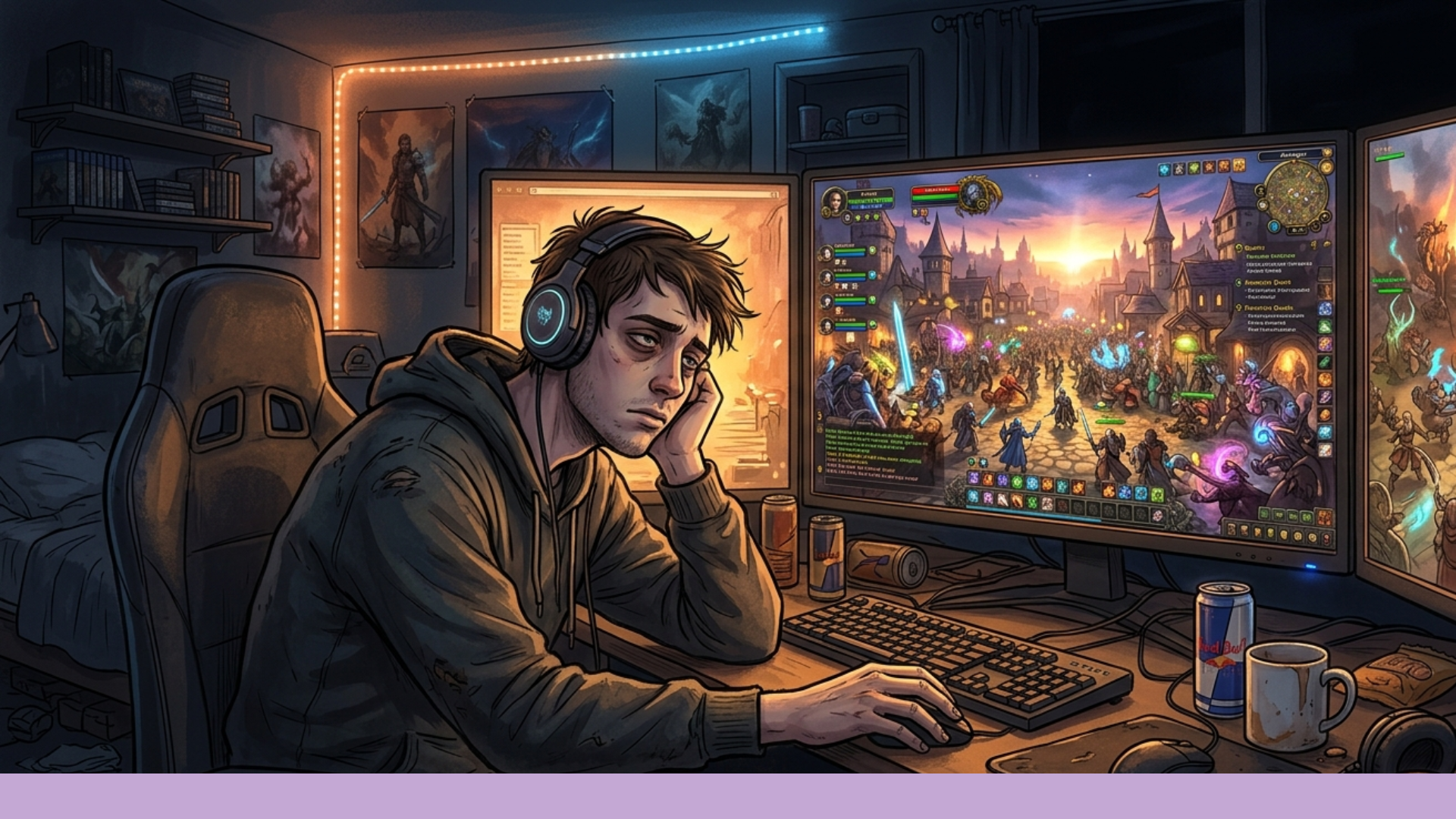
I spent hours, evenings, entire weekends on World of Warcraft and Dofus.
Not just playing: genuinely investing myself, with the ambition of reaching the highest levels, joining the best guilds, being part of the endgame content. What I hadn't anticipated was how much that ambition would transform my relationship with the game.
The drift
The change didn't happen overnight. Far from it.
At first I played because I loved it, because the world was vast, because the progression felt satisfying, because everything was waiting to be discovered.
Then gradually, without really noticing, the game became a list of obligations.
I had to log on.
I had to keep progressing.
I had to be there for the raid, for the XP session, for the weekly event.
If I missed something, I fell behind.
And if I fell behind, I became invisible, and eventually replaceable.
A low-grade pressure
In my case, the pressure was self-imposed, not driven by other players, but by what I anticipated: if my level isn't high enough, I won't get invited.
If I'm not online regularly, the guild won't count on me. If I don't optimize my character, I'll be the weak link.
It's a form of social anxiety, transposed into a virtual world.
And the game, by design, feeds it perfectly. Progression systems, leaderboards, content locked behind the highest tiers: everything is built to make me feel like I'm constantly falling behind someone.
At some point, I was playing the way you go to work. A minimum number of hours per day, an obligation to deliver results, the feeling of having to answer to someone. A second job, without the benefits.
The signal
The realization came gradually. Several evenings in a row, I was logging on with zero enjoyment. Not a passing wave of boredom, but genuinely not wanting to be there.
I launched the game because I had to launch it. To progress, to show I was present, to not fall out of step with everyone else. The game had become just another obligation.
Cutting the cord
I quit. Without warning, without explaining myself to anyone. I just stopped.
That need to leave without negotiating, without a transition — that says something: when a hobby becomes heavy enough that you walk away from it like slamming a door, something has genuinely gone off the rails.
Goodbye Azeroth, goodbye the World of Twelve.
Coming back, but differently
I did return to my favorite MMORPGs, but on different terms. On the vanilla versions — WoW Classic and Dofus Retro.
Lighter mechanics, less demanding, and above all a community playing mostly out of nostalgia. The social pressure is much lower. You rediscover something simpler, closer to what drew you in to begin with.
But on the current versions, I struggle. The frustration of never having reached that level left a mark. The games share the same name, but they don't feel the same anymore.
What this says about us
I know I'm not alone in having gone through this. There's no shortage of accounts online, creators have spoken about it, and pretty much every player who has ever taken an MMORPG seriously recognizes this drift.
What's striking is that nobody forces us into it. The game doesn't hold a gun to our heads. But it's designed to create this dependency: permanent progression, the fear of exclusion, the social reward of high-level status. We voluntarily impose on ourselves a pressure that most real jobs wouldn't dare ask of us.
The deeper question it raises is about our relationship with leisure and performance. Why do we reproduce, in our moments of downtime, the same patterns of demand and anxiety we're trying to escape in the first place? Maybe that's the real question the MMORPG poses. Not about the game, but about us.
So what now?
It may sound like a cliché, but as with many things, it all comes down to balance and what you're looking for in the experience. I still love these games just as much, and I remain convinced that for many players, chasing the highest level and peak performance is a genuine source of satisfaction. They find real pleasure in it, and that's entirely legitimate.
That said, it's worth remembering that video games remain, for the vast majority of players, a leisure activity. A pleasure. And one that shouldn't tip over into the kind of addiction that gets caricatured all too often by the media or by those who don't really know the world.
Leave a Reply